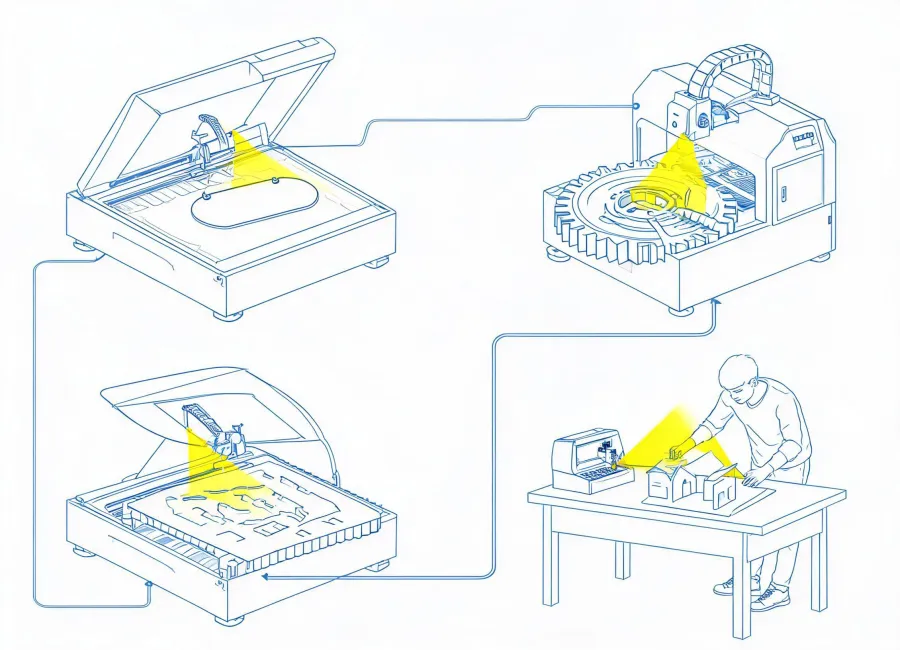
Signage and display production
Acrylic edge appearance, small-feature stability, masking behavior, sheet utilization, exhaust, and large-part handling shape the workflow. A CO2 laser often suits organic materials and acrylic, while coatings and unknown plastics still require documentation review.
- Inspect
- Edge clarity, corner heat, residue, dimensional fit
- Test unit
- Representative nested geometry, not a simple square
Industrial identification
Metal grade, surface treatment, required contrast, code readability, line width, and cycle pattern influence whether fiber marking, coating removal, or another process is appropriate. Mark appearance must be checked under defined lighting and, where relevant, after cleaning or wear exposure.
- Inspect
- Contrast, line definition, heat effect, permanence
- Test unit
- Actual finish and smallest production code
Personalization and short runs
Frequent artwork changes shift attention toward job setup, fixture repeatability, focus practice, material loading, and operator inspection. Laser-on time alone understates the batch cycle when handling and approval dominate.
- Inspect
- Placement, visual consistency, setup time, rejects
- Test unit
- A representative mixed-order batch
Packaging, models, and fabrication aids
Paperboard, wood, laminates, foams, and approved polymer stock respond differently to heat and airflow. Fine features may favor one parameter window while long cuts expose smoke, distortion, or handling limits.
- Inspect
- Char, smoke deposit, tab integrity, flatness
- Test unit
- Longest path plus smallest repeated feature